
Integration Meetings
Integration Meetings are focused meetings for leaders to apply and reinforce Culture Management Models and Tools. These quarterly meetings begin shortly after the development of Cultural Beliefs®, and are focused on building on the concepts introduced in earlier workshops. Integration Meetings serve as a valuable platform for applying, coaching, and learning, enabling you and your team to become experts in Culture Management.
Overview
Integration meetings usually take place about six weeks after the organization’s Cultural Beliefs are developed and then take place quarterly. Agendas are set in collaboration with the organization’s leaders and will typically involve discussions of progress made and needed.
Each Integration meeting is paired with a “Return and Report” meeting that follows within 90 days after the Integration Meeting. In Return and Report meetings, leaders will recap their progress on the commitments they made to demonstrate the skills from the associated Integration Meeting.
Types of Integration Meetings
Focused
Decisions
Evaluate and make decisions through the lens of your desired culture.
Cross-Functional Feedback
Exchange feedback and create a plan to respond to key and immediate business issues.
Leader
Beliefs
Identify and shift undesired beliefs related to a leader.
SOSD
Leadership-focused meeting to apply the models and tools to close accountability gaps and impact key results.
Outer Ring
Leadership team exercise to better establish expectations with the team in a way that aligns with their new culture.
Inner Ring
Leadership tool to better manage unmet expectations (or expectations that are in jeopardy of being unmet).
Levels of
Ownership
Identify and elevate ownership by understanding who owns what.
Experience
Types
Understanding communication and the kinds of experiences that it creates for people.
Leading Culture Alignment
Understanding and championing your role in leading Culture Alignment.
Focused Decisions Integration Meeting
This meeting focuses on the process in which leaders make decisions and provides a framework to help them think through how these decisions impact (and reinforce) their aspired culture (C2).
The meeting unpacks the decision-making process into three steps:
- Link – building and articulating a compelling case for the decision
- Commit – making the decision
- Interpret – communicating the decision
Focused Decisions Model
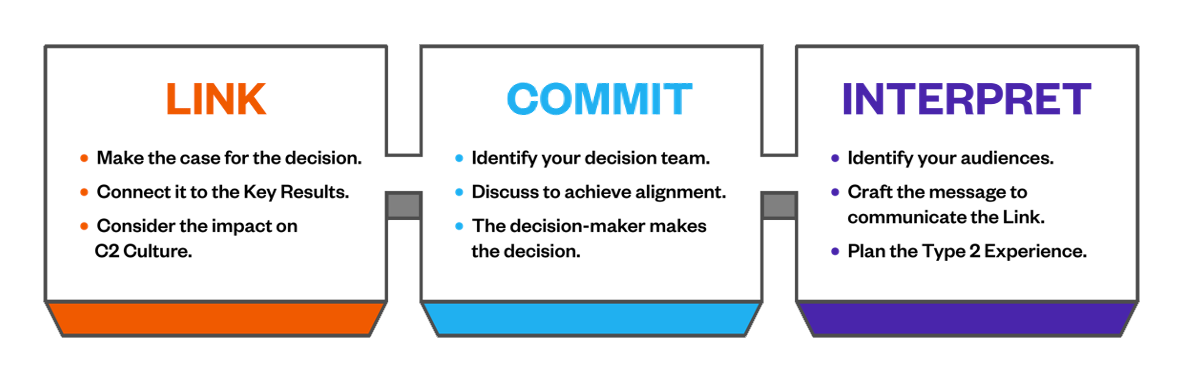
To apply this framework, the group will look at a key, upcoming decision and work through a series of questions designed to help leaders link that decision to their Key Results and C2 culture of their organization, agree and commit to that decision, and then build out a series of communications to ensure that stakeholders can correctly interpret that decision.
Key Resources
Cross-Functional Feedback Integration Meeting
This meeting focuses on expanding the application of the Focused Feedback model from individuals to teams and functions. This is a critical step in creating a healthy feedback process that emphasizes directness and doesn’t rely on misinterpretation from one person to the next.
Cross-Functional Feedback®
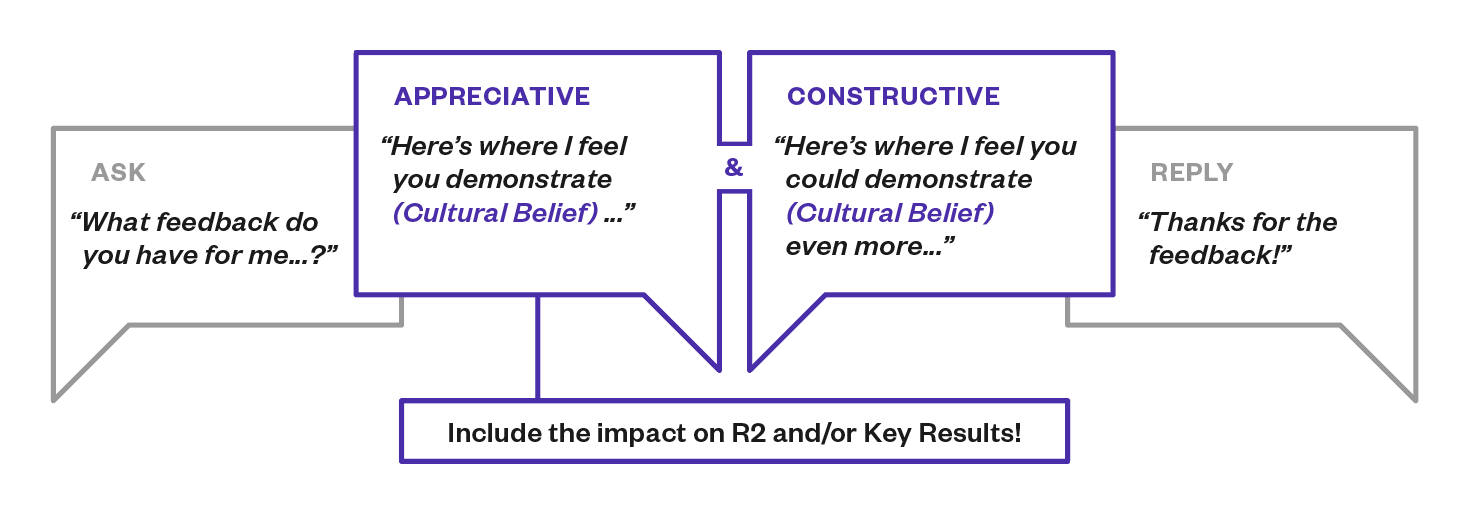
Specifically, this meeting creates opportunities for team leaders to go directly to each other to seek and offer feedback. It also expands on a method for functional teams to go through the feedback they received, and identify the beliefs and experiences behind it. This allows the team to create a plan for changing those beliefs, and ultimately respond constructively to the feedback given.
Key Resources
Leader Beliefs Integration Meeting
The Leader Beliefs integration meeting focuses on collecting and reviewing feedback for leaders to help them identify and change their beliefs about themselves, and how they work with their colleagues. Before this meeting, assessments are sent to each member of the leaders’ teams, feedback is collected, and themes are presented.
In receiving both appreciative and constructive feedback, leaders are challenged to identify two beliefs they would like to shift, and brainstorm possible experiences they can create to shift them. From there, leaders develop a plan to shift those beliefs, with progress presented at the “Return and Report” meeting.
Key Resources
SOSD Integration Meeting
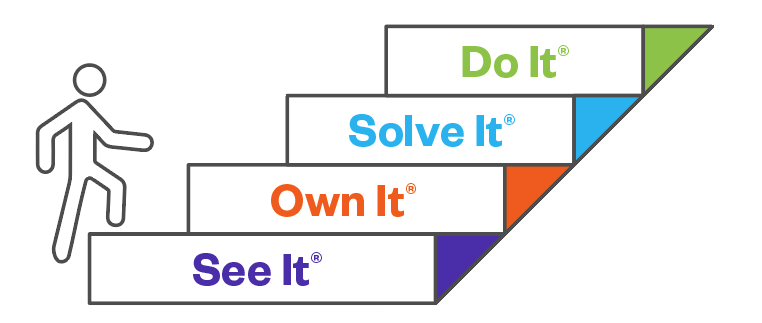
This meeting focuses on utilizing the SOSD Model to close identified Accountability Gaps. This is a critical skill for your people to practice so they know how to apply the SOSD model in their day-to-day role. In the lead up to this meeting, members of the leadership team will be interviewed and themes from these interviews will be reviewed in the planning call for this meeting.
The attendees will identify accountability gaps in their own work, and learn how to use the SOSD model to close a key gap in performance that is inhibiting their ability to achieve an organizational Key Result. Their next step will be to review their progress in a Return and Report meeting and acknowledge the work they still need to do to close the gap.
SOSD®
Key Resources
Outer Ring Integration Meeting
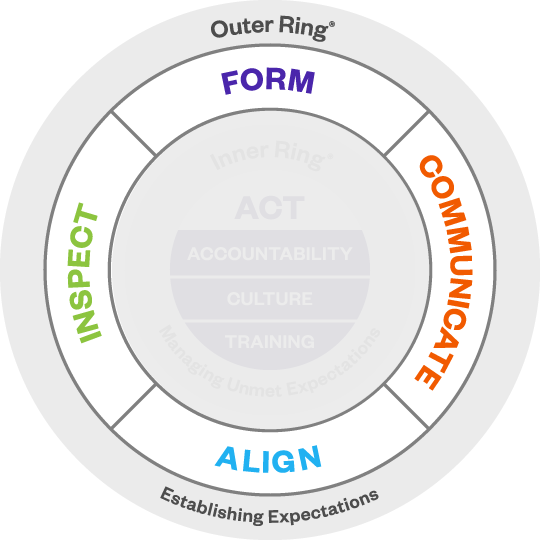
This meeting is focused on introducing the Outer Ring of the Accountability Sequence and establishing Key Expectations for team members. At a high level, the Outer Ring shows leaders how to establish an expectation in such a manner that everyone involved can engage effectively.
The Outer Ring model provides leaders with the tools to communicate expectations, align on these expectations with their direct reports, and then check to see that the expectations have been met. The attendees will come away with a practical Weekly Accountability Plan to continue establishing expectations and sharing how those expectations are supporting the Key Results of the organization. Before this meeting, the leadership team will be interviewed on what Key Results are in jeopardy and how they manage unmet expectations.
Outer Ring
Key Resources
Inner Ring Integration Meeting
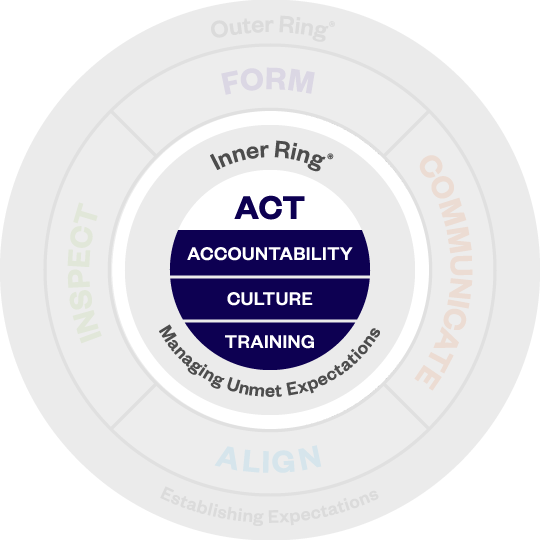
Building off the prior “outer ring” Integration Meeting, the “inner ring” Integration Meeting focuses on how to coach leaders when their expectations are in jeopardy of going unmet. These tools include the LIFT model, where leaders are coached on how to identify and overcome obstacles, and the Experience Dialogue, where leaders identify the experiences that will create new beliefs for them.
It is essential for leaders to be able to solve the obstacles that they encounter to keep the organization on track to achieve its Key Result. Attendees will regroup in the Return and Report meeting to discuss how they have used the LIFT and Experience Dialogue models, and the progress that is still needed to deliver on their Key Results.
Inner Ring
Key Resources
Levels of Ownership Integration Meeting
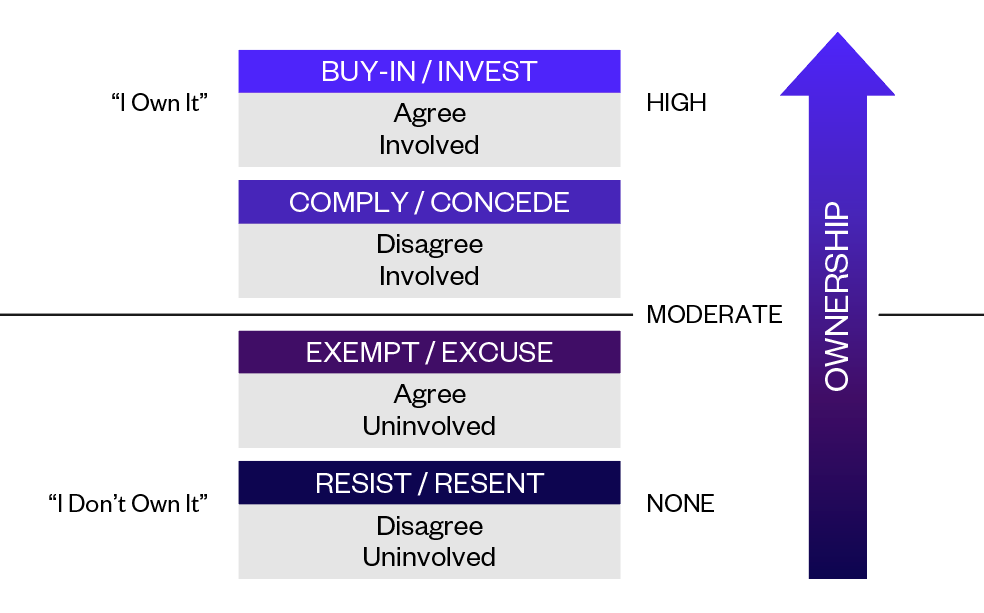
This meeting centers on explaining the Levels of Ownership that individuals can take relating to organizational initiatives based on their agreement and involvement, and the importance of taking ownership over Key Results. Attendees will apply this model to their own ownership over each of the organization’s Key Results, and then identify where their ownership level needs to be addressed.
Taking ownership over Key Results creates a stronger sense of connection and accountability to the organization’s goals and motivates teams to strive more to achieve the Key Results. After the meeting, attendees will meet again to “Return and Report,” how the actions taken have changed levels of ownership, and what they still need to do differently to achieve the Key Results.
Levels of Ownership
Key Resources
Experience Types Integration Meeting
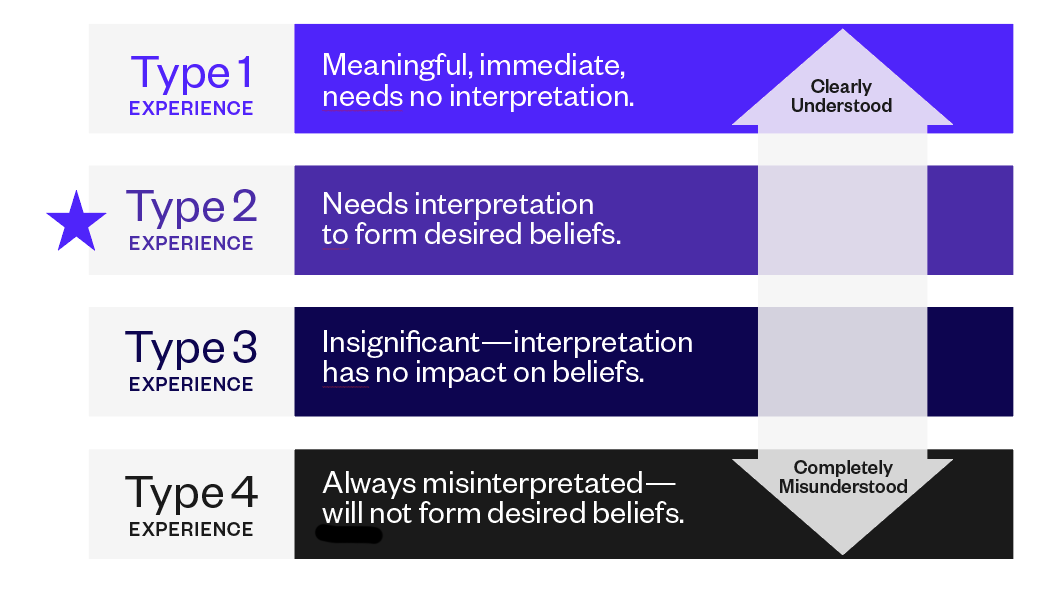
This meeting focuses on interpreting leadership decisions and covers how stakeholders can experience communications and decisions. Through the Experience Types model, leaders will look back at past decisions that have been misinterpreted and how they can ensure future decisions are interpreted in a better light.
The Experience Types model illustrates the different experiences people can have. At one end is Type 1, which is characterized by clarity and ease of understanding, while at the other end is Type 4, where confusion prevails and meanings are completely misunderstood.
Experience Types
Key Resources
Leading Culture Alignment Integration Meeting
This leader-focused meeting dives into understanding your role as a culture leader. Leaders analyze the specific experiences they need to continue, stop, and start to help shape beliefs. Using the Foundational Culture Management Tools, leaders learn how to create intentional experiences to achieve organizational results.